Ivy on Trees: A Lodger, Not a Thief — How to Tell the Difference
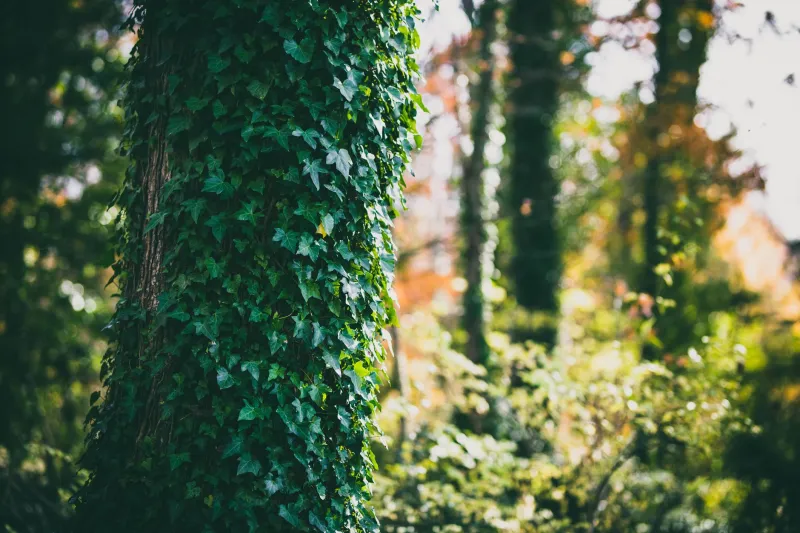
Every autumn, someone in a local Facebook group posts a photo of a mature oak wearing a full green overcoat and asks the same question: is the ivy killing it? The replies split neatly in two. Half insist ivy strangles trees and should be ripped off at once. Half insist that touching it will finish the tree off, and anyway it is the only thing holding the thing upright.
Both camps are working from folklore. Ivy is neither a strangler nor a structural necessity, and the decision to keep it or cut it should come down to one boring question: can you actually see the tree underneath?
Ivy is a lodger, not a thief
Common ivy, Hedera helix, roots into the soil and feeds itself. The little pads gripping the bark are anchors, not mouths. It takes no sap, no water and no nutrients from the tree it climbs. If the ivy on your tree is thick and the tree looks well, the ivy is not the reason.
What ivy genuinely does is three things. It adds weight and wind sail, which matters on an old tree with a compromised root plate. It competes for light once it reaches the crown, and can smother the branch tips of a smaller or already struggling tree. And it hides things, which is the one that should worry you.
The real problem is what is under the blanket
A tree can be dead, hollow or quietly rotting at the base for a decade and the ivy will keep it looking lush and green from the pavement. That is the illusion. The danger is rarely the ivy itself; it is the fact that nobody has been able to assess the tree since the 1990s.
So the sensible position is this: ivy is an inspection problem, not a moral one.
The ten-minute check you can do from the ground
You do not need ropes for this. A torch, a pair of binoculars and a slow lap of the tree will tell you plenty.
- Walk right around it. Ivy usually grows heaviest on one side, often the shaded or damper one. The clean side is where you will see the trunk, and where you will spot defects the green side is concealing.
- Look at the base. Fungal brackets, splitting bark, oozing patches, a hollow where there should be solid wood, cracks or heave in the soil around the roots.
- Look up through the gaps. Can you see any of the tree's own foliage at the tips, or is the crown entirely ivy? A tree with no visible leaves of its own in July is a conversation starter.
- Check the lean. Compare it with old photos. A lean that has changed is more interesting than a lean that has always been there.
- Check whether the ivy is holding the tree together. On a hollow shell, the ivy can be doing structural work. That changes everything about how it should be removed.
If you cannot answer those questions because the ivy is too dense, that is the moment a professional visit earns its fee. Paying for one inspection is cheaper than paying for a climber to strip ivy off a tree that turns out to be a hazard.
When leaving it alone is the right and cheapest call
Healthy tree, ivy below the crown, nothing valuable underneath it: leave it. Ivy is one of the most useful wildlife plants in Britain. Dense mature ivy is nesting cover for blackbirds, robins, wrens and house sparrows, and roosting cover for bats. Hibernating brimstone and small tortoiseshell butterflies tuck into it. The ivy bee, which only reached these shores in 2001, feeds on it almost exclusively, and the holly blue butterfly lays its eggs on it.
Then there is the timing. Ivy flowers in September and October, when almost nothing else is in bloom, and it is a lifeline for bees, hoverflies and wasps stocking up before winter. The berries ripen in late winter and feed thrushes and blackcaps.
None of that improves the tree's health, but cutting ivy off a healthy tree does not improve it either. It is cosmetic work. If someone is quoting you several hundred pounds to strip a sound tree on the basis that the ivy is draining it, ask exactly what the money is buying.
When it stops being cosmetic
There are good reasons to act, and they are all about risk rather than aesthetics:
- The tree is dead or dying and the ivy is holding the crown together.
- Ivy has reached the upper crown and is smothering the branch tips of a tree you want to keep.
- The tree overhangs a road, footpath, driveway, shed, play area or a neighbour's roof.
- There is storm damage, a visible defect, or you need the tree climbed and inspected.
- The tree is on a boundary and you need to know, in writing, that it is sound.
The cut-band method, and why tearing it off is a bad idea
Ripping live ivy off a mature tree tears bark, snaps out live stubs and opens wounds that were not there before. On an old tree, that can be the push it did not need.
The standard approach is gentler and much less work. Clear the ivy away from the trunk face so you can see what you are cutting, then sever every ivy stem in a band about 30cm deep all the way around the trunk at roughly waist height. Every stem, including the ones hidden round the back and in the crotch of the tree. Then walk away.
The ivy above the cut dies back over the following months, when it is lighter, brittle and far easier to remove. Regrowth from below the band is a repeat-cutting job, not a spraying job. Two warnings worth taking seriously: check twice that you are cutting ivy and not tree, and do not paint weedkiller onto the cut stems unless you are confident about what the product does in soil and near water.
The legal bits that actually bite
Birds. All wild birds, their nests and their eggs are protected under the Wildlife and Countryside Act 1981 while the nest is in use. Ivy is prime nesting cover, so look before you cut. September to February avoids most of the season, but pigeons and a few others will nest almost year round.
Bats. All UK bat species and their roosts are protected, and a roost does not have to be a hollow. Ivy on a mature tree, particularly on a warm aspect, is used by roosting bats. If you suspect bats, stop and take advice. Disturbing a roost without a licence is a criminal offence, not a slap on the wrist.
Protected trees. If the tree has a Tree Preservation Order or sits in a conservation area, email the local planning authority's tree officer before you arrange anything. The treatment of ivy varies from authority to authority, and a five-minute email now is infinitely cheaper than a conversation later.
The bottom line
Ivy is a symptom, not a disease. It does not need removing because it exists; it needs removing when it is stopping you from knowing whether a tree is safe, or when it is visibly swamping the crown. Spend your money on the inspection first and the climber second, and you will rarely regret either.