The Stump Stays? Rethinking the Bit of Tree You Usually Pay to Remove
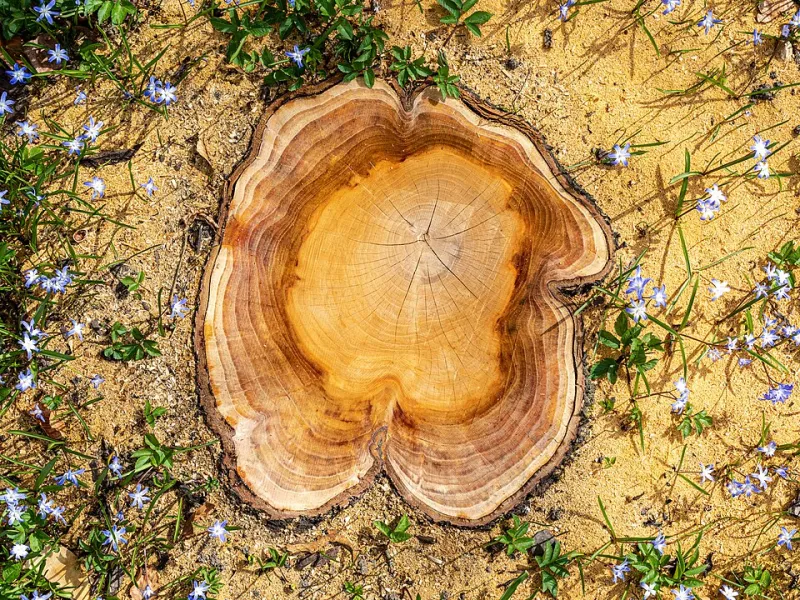
Photo: Dietmar Rabich, CC BY-SA 4.0, via Wikimedia Commons
A tree stump is usually treated as the leftover bit of a job. The tree comes down, the stump gets ground out, the hole gets filled, and the garden moves on. That is often the right answer. But it is not the only answer, and the stump debate is worth having before the grinder arrives.
In a UK garden, a stump can be an ecological asset, a practical nuisance, a disease risk or all three depending on where it sits and why the tree came down. The trick is to stop thinking of it as waste and start thinking of it as a decision.
The stump is not just a lump of dead wood
Standing deadwood is one of the more underrated features of a wildlife-friendly garden. A stump left in a quiet corner can host fungi, beetles, solitary bees and all the small creatures that depend on decaying wood. As it softens and cracks, it becomes a nursery for moss, ferns and seedlings. Birds may use it as a perch or a foraging stop. In a small garden, that is a decent return for something that would otherwise become a bag of grindings.
There is also a slower pleasure to it. A stump that is allowed to decay becomes a record of the tree that stood there. It can be planted around, used as a natural plinth for a pot, or simply left to do its own thing behind the shed. If the garden is already wildlife-led, leaving a stump is a coherent choice rather than a lazy one.
Where a stump earns its place
The best candidates are out of the way. If the stump sits at the back of a border, away from paths, patios, drains and play areas, and it is not throwing up a forest of new shoots, leaving it is usually low-risk. It helps if the tree was healthy when it was felled and if the stump is not close to a building or a boundary structure.
A stump can also be deliberately managed as a habitat feature. Some gardeners leave it at a low height, perhaps 15 to 30 centimetres, so it is visible but not a serious trip hazard. Others leave a taller monolith where space and safety allow. Either way, the point is to make it intentional: check it occasionally, keep it away from busy routes, and do not let it become a hidden obstacle in long grass.
Where it has to go
A stump becomes a problem when it is in the way. That might mean a trip hazard on a lawn, a obstruction to mowing, a lump under a new patio, or a feature that makes a small garden feel smaller. It also has to go if it is regrowing vigorously and you do not want another tree in that spot.
Many broadleaved trees will send up new shoots from a cut stump. Willow, poplar, sycamore and some cherries are particularly good at it. If you leave the stump, you may be committing yourself to rubbing out shoots for a few seasons. If you want the tree gone, grinding is usually the cleaner answer.
Disease is the other red flag. Honey fungus is the one that makes gardeners nervous. If a tree has died or been removed because of honey fungus, the stump and roots can remain a source of infection for susceptible plants nearby. Grinding removes the visible stump but does not necessarily remove every root, so it is not a magic bullet. In that situation, get advice from an arboriculturist rather than assuming a stump alone is the culprit or the cure.
The practical options
Grinding is the standard domestic solution. A stump grinder chips the stump down below ground level, usually 15 to 30 centimetres, so you can backfill the hole and replant or turf over it. It is quick, tidy and effective, but it creates a pile of grindings and a hole that needs dealing with. Access matters too: if the stump is at the bottom of a narrow side path, the machine may not fit.
Leaving the stump is the low-cost option, but it is not a no-maintenance option. You may need to manage regrowth, watch for decay near paths, and accept that the stump will slowly change shape as it rots. Chemical stump killers exist, but they are not usually necessary for a domestic garden and should be used only with care and according to the label, especially near plants you want to keep.
A middle path is to make the stump a feature. Plant around it, place a planter on top, or turn it into part of a log pile. It can look deliberate rather than neglected, and it saves the cost and disturbance of grinding.
A simple decision framework
Ask four questions. Is it in a place where someone could trip, or where you need to mow or build? Is it regrowing strongly? Is there any sign of honey fungus or another significant decay problem? Do you actually want the wildlife benefit, or would you rather have the space back?
If the stump is safe, out of the way, not regrowing badly and not linked to a disease problem, leaving it is a defensible choice. If it is a hazard, a nuisance, a regrowth factory or a disease question mark, grinding is usually the sensible route. If you are unsure, get a professional opinion before spending money on either option.
The humble stump does not have to be an embarrassment. Sometimes it is a habitat. Sometimes it is a hazard. The important thing is to decide which one you are looking at, rather than letting the grinder make the choice by default.