The Dormant Pruning Rulebook for UK Apple and Pear Trees
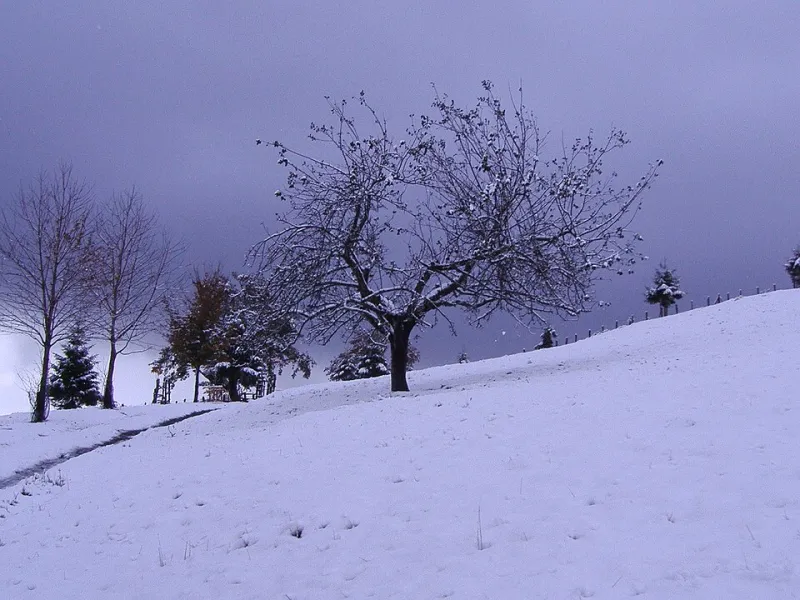
Photo: Milartino, CC BY-SA 3.0, via Wikimedia Commons
November is the month when the pruning saw comes out of the shed. The leaves are down, the structure is visible, and every garden programme tells you it is the right time to prune fruit trees. All true — but only if you understand what you are cutting. A heavy-handed winter prune can remove the very wood that would have carried next September's apples.
Dormant pruning is a light conversation, not a haircut
Fruit trees are not hedges. Apples and pears crop best on a framework of older wood, with short fruiting spurs sitting on branches that have had time to mature. The dormant season — roughly leaf fall to bud burst — is when you can see that framework clearly. But the tree is also storing energy in its roots and trunk, and a hard winter cut tells it to respond with vigorous growth in spring. That growth usually arrives as long, upright water shoots. They look impressive. They do not carry fruit. They shade the spurs that do.
Know your spurs from your water shoots
Before you cut anything, learn two shapes.
Fruit spurs are short, stubby and often slightly wrinkled. They sit on older wood and carry the flower buds that become apples and pears. On many apple varieties they are 2–10cm long and cluster along the branch. Leave them alone unless they are crowded or damaged.
Water shoots are long, straight, vertical and vigorous. They often sprout from old pruning cuts or from branches that have been suddenly exposed to light. They are the tree's emergency response. Remove the ones that are crossing or crowding the centre, and shorten others rather than stripping them all out. A few can be retained and trained, but most are just shade generators.
Also check whether your tree is spur-bearing or tip-bearing. Most UK apples — Cox, Discovery, Egremont Russet — crop mainly on spurs. Bramley is partial tip-bearing, so its fruiting tips matter. Pears are mostly spur-bearing. If you are not sure, leave the tips alone and remove only dead or crossing wood.
A three-step November audit for apples and pears
Step one: stand back. Look at the shape and the light. A mature apple tree should have an open centre, like a goblet, with branches spaced enough that air and sunlight can reach the middle. Walk around it. Note dead, diseased, damaged and crossing branches. Those come out first.
Step two: remove the three Ds. Dead, diseased and damaged wood can go now. Make clean cuts and do not leave stubs. Then look at congestion. If two branches rub, remove the weaker one. If the centre is a tangle, thin it — but aim to remove no more than about 20 per cent of the canopy in one winter. That is a maximum, not a target.
Step three: make the cut count. Use sharp bypass secateurs for small wood and a pruning saw for anything thicker than your thumb. Cut back to the branch collar — the slight swelling where branch meets trunk — rather than flushing the cut. Do not paint wounds; modern advice is to leave them clean and dry. Shorten water shoots to two or three buds if you are keeping them, or remove them entirely if they are in the way. And leave the fruiting spurs. That is the whole point.
The stone fruit warning
Plums, cherries, peaches, nectarines and apricots are different. They are prone to silver leaf and bacterial canker, both of which enter through winter wounds. Prune them in summer, ideally late June to August, when the sap is rising and wounds dry quickly. If a stone fruit branch breaks in winter, remove the damaged wood cleanly, but do not embark on a tidy-up prune in November. That is a job for a dry summer day.
When to call in an arboriculturist
A small garden apple tree on a dwarf rootstock is a reasonable DIY job. A mature pear tree, a restored orchard, a tree under a Tree Preservation Order, or anything near a building or power line is not. Call an arboriculturist if you cannot identify the cultivar, if the tree has canker or fireblight, or if you need to work at height. A professional will also tell you when the kindest prune is no prune at all.
A light hand in November gives you blossom in spring and fruit in autumn. The tree does not need a haircut. It needs a considered edit.