The Branch You Can Leave: Judging Deadwood Risk Without Stripping a Tree Bare
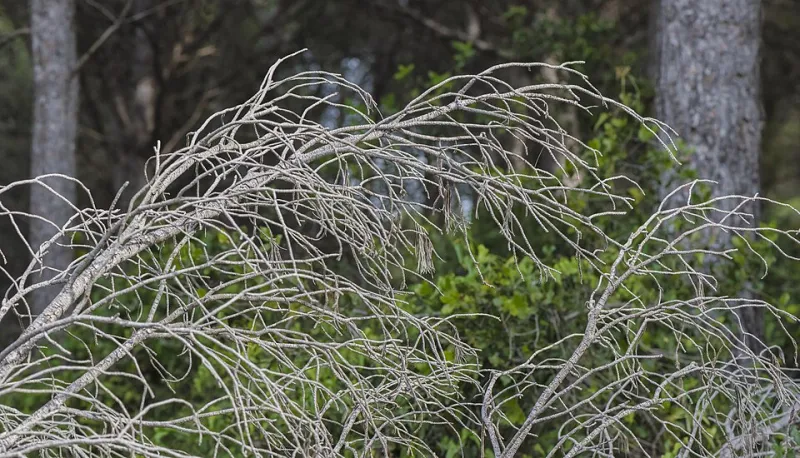
Photo: Christian Ferrer, CC BY-SA 4.0, via Wikimedia Commons
Deadwood gets a bad name. A tree surgeon points up at a bare limb, a homeowner sees a disaster waiting to happen, and before long the whole crown has been thinned out to within an inch of its life. Sometimes that work is justified. Quite often, it is not. The trick is separating a genuine hazard from the natural, useful, wildlife-friendly deadwood that has been part of healthy trees for as long as trees have existed.
Start with the target, not the branch
A dead branch is only a problem if it can hit something that matters. That is the first question to ask, and it is much more useful than simply counting dead limbs. A modest dead branch over a flower bed is a very different proposition from the same branch hanging above a driveway, a conservatory, a footpath or the spot where the kids play. In tree-risk language, that something is the target. No target, much lower risk.
So before you panic, stand back and look at what sits beneath the tree. Is it a well-used garden? A parking space? A neighbour's greenhouse? A public pavement? A dead limb over open lawn that nobody walks under is not the same emergency as one over the school run route.
Look for the clues you can see from the ground
You do not need to climb the tree to make a sensible first assessment. A pair of binoculars and a slow walk around the trunk will tell you plenty. Look for dead limbs that are clearly detached or hanging by a thread, especially after wind. Check for cracks at branch forks, splits in the main trunk, or a sudden lean that was not there last month. Fungal brackets near the base or on the trunk are worth noting, as are cavities, loose bark and areas where the tree looks like it is hollowing out.
Context matters too. Is the tree in leaf while one section stays stubbornly bare? Are there several dead limbs on one side? Has the ground around the base lifted or cracked? These are not automatic removal orders, but they are reasons to look more closely.
What you cannot do from the ground is test how strong a limb actually is. A branch can look sound and be rotten inside. Another can look grim and still be firmly attached. That uncertainty is exactly why a professional assessment exists.
Deadwood is not automatically rubbish
Here is the part that often gets lost in the rush to tidy up: deadwood is habitat. Standing dead branches and decaying wood support fungi, insects, birds and bats. In the UK, ancient and veteran trees are valued precisely because they carry deadwood, hollows and decay features that take centuries to develop. Even a modest garden tree can do its bit. A dead limb high in the crown may be feeding a whole small ecosystem while posing very little risk to anyone below.
The answer is rarely 'remove every scrap of deadwood'. It is more often 'remove the bits that matter and leave the rest'. A tree that has been stripped back to a tidy skeleton is not necessarily safer; it may simply have lost the features that made it useful to wildlife, and it may have been put under unnecessary stress.
When a professional assessment is worth the money
There is a time to stop squinting from the patio and call someone in. If a large dead limb hangs over a target, if there is a crack or split in a main stem, if a fungal bracket sits at the base, or if the tree has moved after a storm, an assessment is sensible. The same goes for trees with multiple dead limbs, trees near buildings, and trees where you simply cannot tell what is going on.
A good arboriculturist will not automatically reach for the chainsaw. They will look at the tree, consider the target, and give you a view on risk. That might mean selective deadwooding, a reduction, monitoring, or no work at all. Ask for the reasoning in writing, especially if the tree is large or close to a boundary. If the tree is protected by a Tree Preservation Order or sits in a conservation area, check before any work is booked in.
The middle path: selective deadwooding
The practical answer for most homeowners is selective deadwooding. That means removing the dead limbs that present a real risk, while leaving sound deadwood where it can be retained safely. It does not mean lion-tailing, topping, or stripping the inner crown. Those shortcuts create more problems than they solve and can leave a tree more vulnerable to wind and decay.
Timing matters as well. Birds, bats and other wildlife have legal protection, so avoid unnecessary work during nesting season and take advice if protected species might be present. A reputable contractor will know what to check and when to pause.
A simple decision ladder
First, is there a target beneath the deadwood? Second, is the dead limb large or poorly attached? Third, are there other defects such as cracks, fungal brackets or a lean? Fourth, can the risk be reduced while leaving safe habitat in place? Fifth, if you are unsure, get advice rather than guesswork.
Deadwood is not dead weight by default. It is part of a living system, and it only becomes a liability when it sits above something worth protecting. Judge the risk, keep the habitat where you can, and spend money on an assessment when the tree gives you a genuine reason to look harder.