A Slant, Not a Sentence: How to Judge a Leaning Tree in Your Garden

Some trees look like they are mid-conversation with the prevailing wind. Others look like they have just remembered something urgent and are heading indoors. To a worried homeowner, both can trigger the same thought: is this thing coming down?
The honest answer is that a lean is a symptom, not a diagnosis. Plenty of UK trees grow at an angle for decades without drama. The question is not ‘is it straight?’ but ‘has it changed?’ A tree that has always leaned is telling one story. A tree that has started leaning is telling a very different one, and that second story is the one worth reading carefully.
First, Stop Staring at the Top
It is natural to fixate on the crown. It is the biggest, most visible bit, and when it is tilted it looks alarming. But the crown is also the most excitable witness. It sways, it thins, it grows unevenly towards light, and it can make a perfectly stable tree look theatrical on a windy Tuesday.
The more reliable evidence is lower down: the root plate, the soil around the base, the shape of the trunk in its first metre or two, and the direction the whole tree is leaning relative to the wind and the light. Think of it as reading a timeline rather than taking a snapshot.
The Difference Between a Habit and an Event
A tree that has grown at an angle since it was young usually shows a smooth, gradual curve in the lower trunk. The wood has spent years adding reaction growth on one side to keep the tree upright, so the base often looks like a gentle elbow rather than a hinge. Roots tend to be well spread and undisturbed, and the soil surface around the trunk looks settled — moss, grass, leaf litter, no fresh cracks.
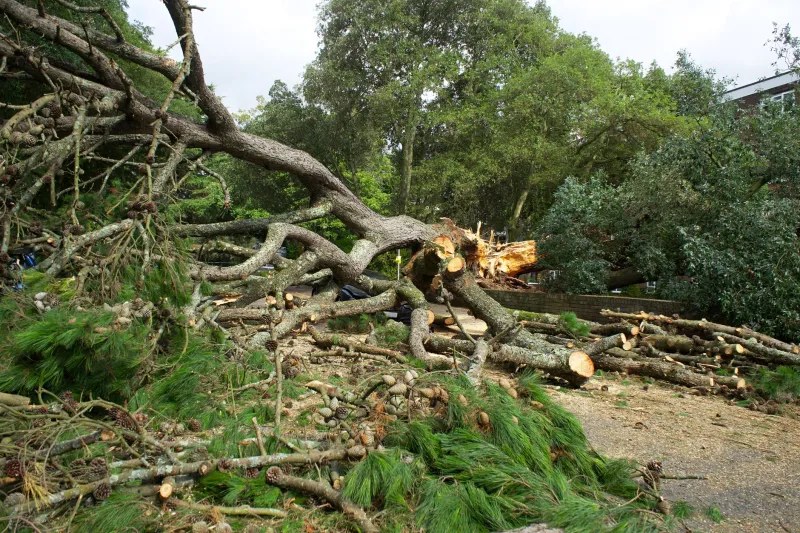
A tree that has moved recently is a messier picture. The lean may be sudden, or it may have crept up over a few months. The root plate can lift on one side, creating a ridge or hump in the soil. You might see fresh cracks in the ground, exposed roots that were previously buried, or a gap opening between the trunk and the soil on the tension side. The lower trunk may look straight but tilted, as if the whole thing has rotated rather than grown that way.
That distinction — grown versus moved — is the heart of it. One is character. The other is a structural question.
A Ground-Level Assessment Routine
You do not need a chainsaw or a clipboard to do a useful first check. You need a dry day, a bit of patience, and a willingness to look at the boring bits.
1. Look from a distance
Stand back further than you think you need to. Look at the tree against a fixed reference — a fence post, a house corner, a lamppost. Is the whole tree leaning, or is it just the upper crown reaching for light? A tree leaning away from a wall or a larger neighbour is often doing exactly what you would expect.
2. Check the root plate
The root plate is the shallow, plate-like mass of roots that many UK trees rely on for stability. Walk around the base. Is the soil level? Is there a fresh ridge on one side? Does the ground look pushed up or dropped down? A lifted root plate is a red flag, especially if it has appeared after wind or heavy rain.
3. Inspect the soil surface
Look for cracks, new exposure of roots, or a gap between the trunk and the soil. Old roots that have always been visible are not necessarily a problem. Freshly exposed roots on the tension side of a lean are worth taking seriously. Probe gently with a finger or a stick — if the soil feels hollow or loose underfoot, stop and call someone.
4. Read the lower trunk
A smooth curve that has been there for years suggests the tree grew into that angle. A straight trunk that is suddenly tilted suggests movement. Also look for cracks, splits, or compression wood — swollen ridges on the side the tree is leaning towards. Some of that is normal reaction growth; fresh cracking is not.
5. Compare the crown to the base
A crown that leans in the same direction as the trunk is usually consistent. A crown that leans one way while the trunk leans another can suggest the tree is compensating, or that something has changed lower down. Look for deadwood, hanging branches, or a suddenly thinner crown on one side.
6. Use old photos and memory
Your phone camera roll is a legitimate tree-survey tool. Compare this year’s photo with one from two or three years ago. If the lean looks the same, that is reassuring. If it has clearly increased, start monitoring properly — and consider getting a professional opinion.
When a Lean Is Probably Fine
A lean is generally lower-risk when the tree has grown that way, the root plate is undisturbed, the soil is settled, and the crown is healthy and balanced. Many UK trees on windy sites — sycamore, ash, oak on exposed ground — develop a permanent slant and live long, useful lives. A tree leaning over a lawn is one thing; a tree leaning over a driveway, a footpath, or a play area raises the stakes and deserves a closer look sooner.
When to Start Monitoring
If you are unsure but see no fresh soil movement, set up a simple monitoring point. Put a cane in the ground a fixed distance from the trunk, take a photo from the same spot each month, and note any change. Check after gales and after prolonged rain. If the lean increases, the soil lifts, or new cracks appear, stop monitoring and get advice.
The Clear Red Flags
Call a professional promptly if you see a freshly lifted root plate, cracks in the soil around the base, exposed roots on the tension side, a sudden lean after a storm, a split or crack in the lower trunk, or a tree leaning towards a building, road, or public path. Do not try to ‘correct’ it by cutting the crown back yourself — removing weight from the wrong place can make a unstable tree more unpredictable, not less.
A leaning tree is not a countdown clock. Most are simply doing what trees do. But the ones that have moved recently are worth taking seriously, and the ground-level clues will tell you which is which — usually long before the next gale does.