When a Tree Grows a Y: Spotting Split Risk in a V-Shaped Trunk
Photo: V-shaped co-dominant tree trunk fork in UK garden, via c8.alamy.com
Most tree failures in UK gardens are not mysterious. They are often the result of a weakness that has been quietly developing for years, usually high up in a fork where two main trunks meet. From the lawn it can look like a perfectly healthy tree. Up close, that tight V-shaped join may be a split waiting for the right gust.
How a tree ends up with two main trunks
A tree with two competing leaders is said to have co-dominant stems. Instead of one clear central trunk carrying the crown, two stems grow upward with roughly equal vigour. This can happen naturally, especially in fast-growing species such as willow, poplar, sycamore, ash and some conifers. It can also follow damage to a young leader, hard pruning, or the way a tree was raised in the nursery.
Not every fork is bad news. A wide, U-shaped join with a smooth curve of wood between the stems is usually much stronger than a narrow V. The trouble tends to start when the two stems sit so close together that bark gets trapped between them as they thicken.
The problem with included bark
In a healthy union, wood fibres knit together across the join. With included bark, the bark of each stem becomes sandwiched inside the fork instead of forming a strong woody connection. It acts a bit like a greasy wrapper between two growing columns. The tree can look solid from the outside while the join is structurally weak inside.
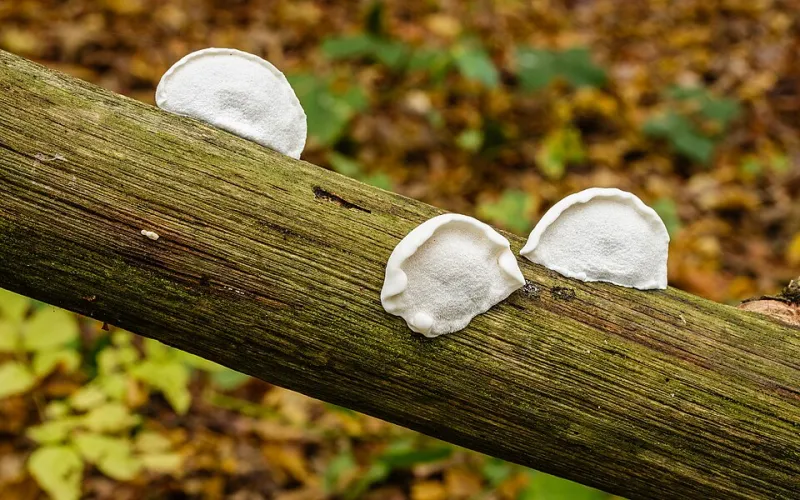
As the trunks put on girth, pressure builds in that tight V. Rain gets in, decay organisms follow, and the fork becomes a lever arm for the wind. You may see a ridged seam, a crack, swelling, dead patches, or fungal brackets around the union. Sometimes there is no obvious outward sign at all, which is why a professional assessment matters if the tree is large or close to something important.
What you can check from the ground
You do not need to climb a tree to make sensible observations. Start with binoculars and a calm day. Look at the fork itself: is it a narrow V with a pinched, bark-filled seam, or a broader U with a smooth join? Are the two stems similar in size, or has one started to dominate? Check for cracks running down from the union, loose bark, cavities, deadwood, or a bulge around the base of the fork.
Then look at the whole tree. Is it leaning more than it used to? Has the crown become dense and sail-like on one side? Are there dead branches caught in the fork? Look at the ground too. Fresh soil cracks, a raised root plate, or a sudden change in the tree’s posture after wind are reasons to keep people away and call someone qualified.
Finally, be honest about targets. A weak fork in a woodland edge is one thing. A weak fork over a conservatory, driveway, play area or neighbour’s garden is another. The risk is not just the tree; it is what the tree can hit.
The cut that can make things worse
One of the most common mistakes is to cut back one side of the fork hard, as if removing half the problem will make the tree safer. It often does the opposite. A heavy cut on one stem can trigger vigorous regrowth, leave a large wound that decays, and unbalance the crown. It may also leave the remaining stem carrying more load than before, with a changed wind profile it was not grown for.
Simply lopping one trunk off and hoping the other becomes the new leader is rarely a tidy solution. The union may still be weak, the wound may be large, and the tree may respond with a thicket of shoots. Any decision to remove one co-dominant stem is a major operation, not a quick tidy-up.
Selective reduction, not topping
Where a tree is worth keeping and the union is not too far gone, a specialist may recommend selective reduction. This means carefully shortening selected outer branches to reduce leverage and weight, rather than cutting the top off or hacking back one whole side. A proper reduction plan works with the tree’s shape and targets the ends of long, heavy limbs that put strain on the fork.
The timing and amount matter. UK trees are living structures, not fence posts, and over-pruning can cause decay, stress and weak regrowth. A good arboriculturist will also check for nesting birds, bats and other wildlife before work begins, and will consider any Tree Preservation Order or conservation area rules.
Cabling and bracing
Sometimes a tree can be supported rather than removed. Cabling and bracing systems can be installed in the crown or across a weak union to limit movement and share load. These are specialist measures, not DIY kits. They need proper design, installation and regular inspection, and they do not cure decay or make a poor union strong. They buy time or manage risk in the right situation; they are not a universal fix.
When removal is the honest answer
If the fork has significant decay, deep cracks, cavities, or a history of movement, and the tree overhangs a house or road, removal may be the sensible option. That is especially true for fast-growing species in small gardens, where the tree may already be too large for its space. Replacing it with a better-suited tree is often a better long-term plan than propping up a problem.
A V-shaped trunk is not automatically a disaster. Many trees live long lives with imperfect forks. But it deserves a second look, not a rushed saw. If you are unsure, get a written assessment from a qualified tree professional, check their insurance, and keep people and parked cars clear of the area until you know where you stand.