The Stake Is a Scaffold, Not a Spine: Rethinking Support for Young Garden Trees
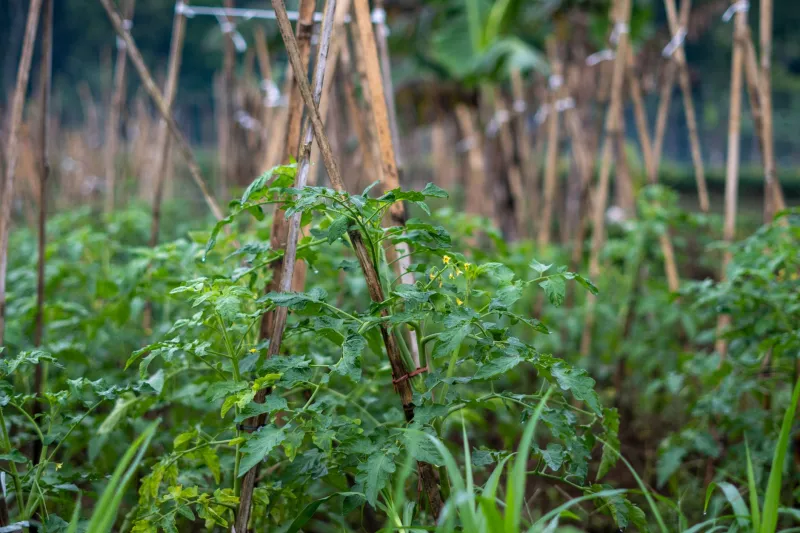
Walk around any new housing estate in the UK and you will see the same well-meant mistake repeated down the street: a young tree clamped to a tall stake with a tie pulled tight enough to strangle a lamppost. It looks tidy. It looks cared for. It is often the worst thing you can do to a tree in its first few years.
The usual problem is not neglect. It is over-help. Many homeowners stake too high, tie too firmly and leave the supports on for far too long. The result is a tree that has been held up so thoroughly it never learns to hold itself up. The stake becomes a permanent crutch, and the tree becomes weaker for it.
What a stake is actually for
A newly planted tree has a small root system compared with its top. In the first season or two, wind can rock the rootball before roots have spread into the surrounding soil. A stake is there to stop that movement at the base, not to stop the trunk moving altogether.
That distinction matters. Trees respond to gentle movement by building reaction wood, which thickens and strengthens the trunk. A tree that sways a little in a breeze is doing exactly what it should. A tree that is rigid from ground to crown is being denied that workout.
The stake is a temporary scaffold. It is not a spine.
Height: lower than most people think
A common sight is a stake reaching two-thirds or more up the trunk, with a tie near the top. That is too much. As a rule of thumb, the stake should be around one-third of the tree's height, or at least well below the lowest branches, so the trunk above it can still flex.
Position the stake on the windward side, which in most of the UK means the side the prevailing south-westerlies come from. That way the tree is supported against the wind rather than pushed into the stake. For container-grown trees with a rootball, the stake should go through the rootball and into the ground beneath, not alongside it like a spare fence post.
If the stake reaches into the canopy, it is probably doing the tree's job for it.
Ties: firm, not fierce
A tree tie should hold the trunk steady without gripping it. The old figure-of-eight method still works well because it spreads the load and allows a little movement. A proper rubber or webbing tree tie with a buckle is better than garden string, cable ties or wire threaded through a bit of hosepipe.
The test is simple: you should be able to slide a finger between the tie and the trunk, or see a small gap. Check the tie each spring and again in late summer. Trees put on girth, and a tie that fitted in March can be biting by July. A tight tie can girdle the trunk, damage the bark and leave a permanent wound.
The two-season rule
Most young garden trees should be free of their stake after two full growing seasons. On an exposed coastal site or a very windy ridge, you might stretch to three. Beyond that, you are usually storing up problems.
Check the tree before removing the stake. Give the trunk a gentle push near the base. If the rootplate feels firm and the tree stands up on its own, cut it free. If it still feels loose, loosen the tie rather than tightening it, and review again in a few months. Do not simply leave the stake in because it feels safer. It usually is not.
When you remove the stake, take the whole thing out. Sawing it off at ground level and leaving the bottom to rot is a job half done.
What happens when support stays too long
The damage is often invisible until it is serious. A long-staked tree may develop a thinner trunk than an unstaked one because it has not had to strengthen itself. The tie can rub or girdle the bark. The root system may spread less widely. And the tree can become top-heavy above a point of support that is no longer doing anything useful.
There is also the simple matter of risk. A tree that has been staked for a decade is not a safer tree. It is a larger tree with the same reliance, and a bigger sail area when the stake finally fails or is removed.
When staking is the right call
None of this means you should never stake. Bare-root whips on exposed sites, large rootballed specimens, top-heavy cultivars and trees planted on slopes or in very light sandy soils may all benefit. But the support should be the lowest effective stake, with a flexible tie, for the shortest sensible time.
A small whip in a sheltered suburban garden often needs nothing more than firm planting, a good soak and a mulch ring that does not touch the trunk. If it stands up on its own after planting, let it.
A quick checklist for planting day
As the 2026 bare-root season gets going, run through this before you walk away with the spade:
- Is the stake around one-third of the tree's height, and below the lowest branches?
- Is the tie flexible, with a small gap between tie and trunk?
- Is the stake on the windward side?
- Have you removed any nursery ties or labels that could rub?
- Is the tree watered in properly, with a mulch ring rather than a mound against the bark?
- Have you noted a removal date in your phone for two growing seasons' time?
That last point sounds trivial, but it is the one most people forget. A stake left in place is not a neutral thing. It is an active choice to keep the tree dependent.
When to call in a tree surgeon
For a small garden whip, staking is a DIY job. For a large rootballed specimen, a tree on a slope, a protected tree or anything you are unsure about, it is worth getting proper advice. A tree surgeon can set a large tree up correctly and tell you what support it actually needs, rather than what the garden centre sold you.
The best staking is brief, modest and easy to undo. Give the tree a fair start, then get out of its way and let the wind do its work.